


By Joseph Q. Jarvis | Published: 25 May 2026
Memorial Day is the unofficial start to the summer, and so also closes out the school year. My children attended school years ago, so I’m not much affected by the school calendar now. However, we are all involved in school funding, at least all of us who actually pay taxes. As school funders, we should be interested in school performance. I’m not an expert on education, but I do pay attention to the news about American students, and apparently with each passing year they are doing more poorly in educational achievement.
As a physician with training and experience in public health, I can say with some certainty that poor performance in education leads to poor health later in life. Each additional year of schooling reduces mortality later in life. Adults with higher educational attainment live healthier and longer lives compared to their less educated peers. Men and women without a high school diploma have about 57% chance of reporting fair or poor health, compared to just 9% for college graduates. Adults with less education are more likely to smoke, have an unhealthy diet, and lack exercise. Less educated adults report worse general health, more chronic conditions, and more functional limitations and disability. Americans have worse health than people in other high-income countries, and have been falling further behind in recent decades partially due to the poor health of adults with low education.
The decline in American education has been noticed for decades. The elder President Bush convened a special commission to look into failing public schools in American almost 40 years ago. The commission issued a report about what needed to happen and briefly there was hope that improvement would follow.
However, almost 2 decades later a major consulting firm noted that the downward trend in educational performance in the United States had continued despite the report issued during the first Bush administration. The consulting group, McKinsey and Co., studied what they called “a rising tide of mediocrity” in American education and concluded that our failures to teach our children on par with educational performance in other wealthy nations was costing us in our national economic performance. Almost 20 years ago they posted a report about this ongoing trend which, in part concluded that “A persistent gap in academic achievement between children in the United States and their counterparts in other countries deprived the US economy of as much as $2.3 trillion in economic output in 2008.” Poor education not only leads to poor health, but also poor economic performance.
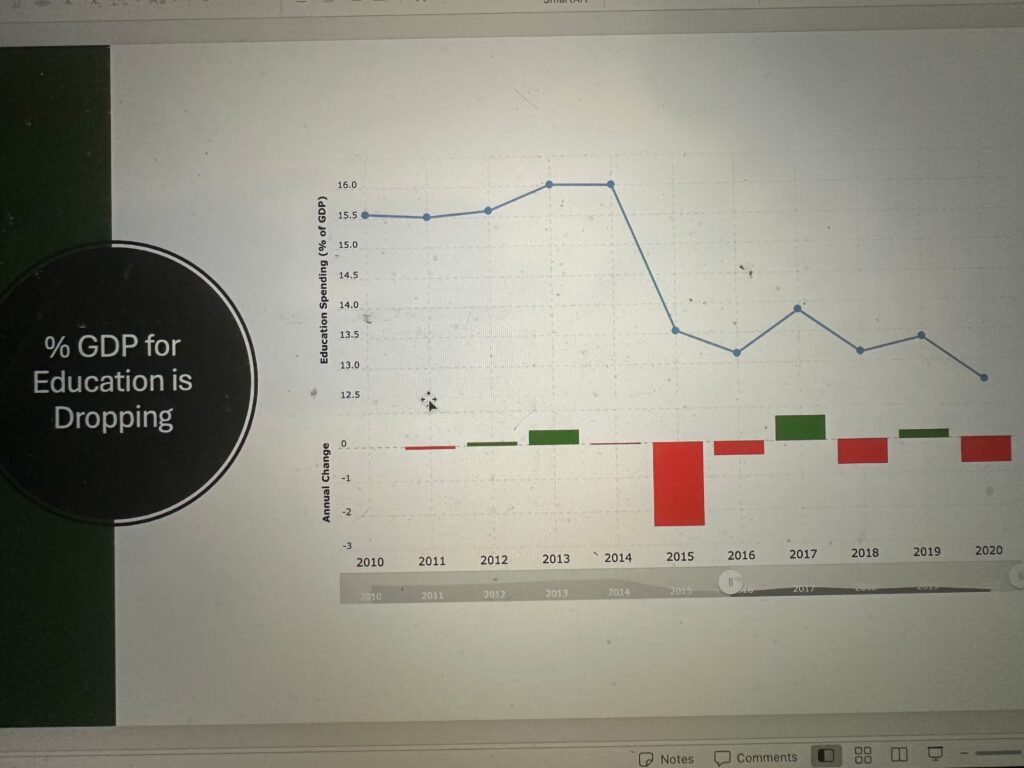
I recently published a statement online that over the recent decade and a half the percentage of GDP going to medical expenditures has increased from 17% to 20%. As I’ve pointed out many times, most health care funding is from public sources or taxes. As such, health expenditures directly compete for public dollars with education budgets. As more and more money is spent on health care, naturally less and less is spent on other portions of the gross domestic product, including education. One source I found about education spending has indicated (see below) that the percentage of the GDP going to education has declined during the decade from 2010 to 2020 from 15.5% to 13%, or approximately the same amount seen as an increase in health spending as a portion of GDP during the same time period.
I am not the only one observing that there might be a relationship between increasing medical spending and the ongoing decline in educational performance in the US. Recently the National Education Association released a statement about this issue. Here are the key takeaways from the NEA report:
1) The cost of healthcare in the US is rising dramatically, putting it out of reach for too many Americans, including educators and students.
2) It’s also eating up school district budgets, making it difficult for school boards to spend money on class-size reductions, educator salaries, etc.
3) The answer, many NEA members believe, is a single payer healthcare system that would operate without CEO bonuses and huge overhead costs, putting more money into actual healthcare.
Here’s a link to the NEA statement:
The Education Case for Single-Payer Healthcare Systems | NEA
On Memorial Day, as we remember the sacrifice of life made to preserve the American way of life, let us also bear in mind the excess loss of life inherent in the current day business practices of US healthcare. The voracious growth of health care profits and budgets comes at the expense of current day patient‘s lives and financial well-being. And, because health care costs dominate public spending, education budgets are shrinking, which leads to future ill health in an increasingly undereducated Anerican public. And, a poorly educated American workforce is increasingly underperforming economically, threatening the future of the American way of life.
This Memorial Day, as the school year ends and the summer begins, resolve to join our nation‘s educators in support of better simpler health care financed fairly for all—single payer health reform. You can learn more about this cause at View source at utahcares.health where you can also DONATE to help get single payer on the ballot!

Dr. Joseph Q. Jarvis is a public health physician, chair of the Utah Cares Political Issue Committee and author of several books, including The Purple World: Healing the Harm in American Health Care and What the Single Eye Sees: Faith, Hope, Charity, and the Pursuit of Discipleship.