


By Joseph Q. Jarvis | Published: 27 June 2026
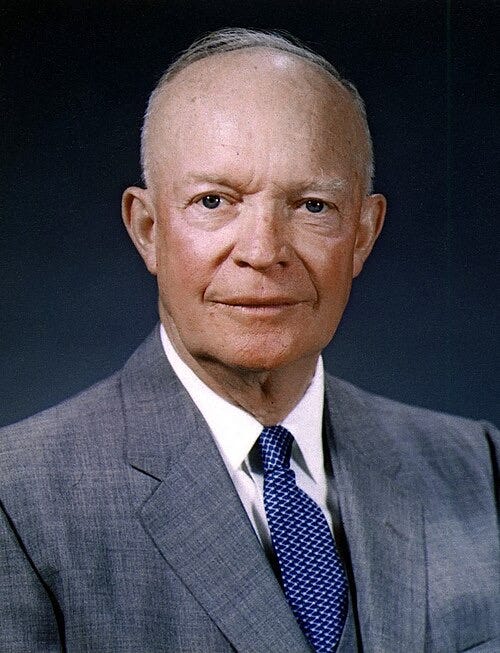
On January 17, 1961, President Dwight D. Eisenhower took to national television to deliver a farewell address to the American people he had served for 50 years. He had been at the helm of American government as the Cold War really took off, and had felt the pressure to match the Soviet Union in weapons development and military growth even though the world was not at war. This was an unprecedented change in approach to military affairs in the United States, with growth of military expenditures leading to growth of a formidable defense industry in the private sector. Eisenhower was worried about the effects that this industry might have on Americans and their economy as it became increasingly powerful. He had had those worries since he first took office as president, stating in 1953 in what became known as the Cross of Iron speech:
“Every gun that is made, every warship launched, every rocket fired signifies, in the final sense, a theft from those who hunger and are not fed, those who are cold and are not clothed. This world in arms is not spending money alone. It is spending the sweat of its laborers, the genius of its scientists, the hopes of its children. The cost of one modern heavy bomber is this: a modern brick school in more than 30 cities. It is two electric power plants, each serving a town of 60,000 population. It is two fine, fully equipped hospitals. It is some fifty miles of concrete pavement. We pay for a single fighter with a half-million bushels of wheat. We pay for a single destroyer with new homes that could have housed more than 8,000 people…. This is not a way of life at all, in any true sense. Under the cloud of threatening war, it is humanity hanging from a cross of iron.”
Here Ike is making the point that any expenditure, public or private, is a choice, not just about what is purchased, but also about what is not purchased, and what won’t be available to future generations. As big as the American economy might be, it is not infinite. Ike was worried that, during his presidency, the economy was skewing towards military might at the expense of more important social goals. In his Farewell Address he noted:
“But each proposal (for spending) must be weighed in the light of a broader consideration: the need to maintain balance in and among national programs-balance between the private and the public economy, balance between cost and hoped for advantage-balance between the clearly necessary and the comfortably desirable; balance between our essential requirements as a nation and the duties imposed by the nation upon the individual; balance between action of the moment and the national welfare of the future. Good judgment seeks balance and progress; lack of it eventually finds imbalance and frustration.”
And further: “In the councils of government, we must guard against the acquisition of unwarranted influence, whether sought or unsought, by the military-industrial complex. The potential for the disastrous rise of misplaced power exists and will persist.”
Ike’s fear about a skewed economy and unwarranted influence ceded to the military industrial complex, the term he coined, was sentient. But it was not the United States which eventually succumbed to overreach of defense spending and industrialization. It was Soviet Union, which almost three decades after Ike’s Farewell Speech, actually collapsed under the weight of too much defense spending.
US defense spending was approximately 10% of GDP as Eisenhower left office. But over the decades since, the percentage of US GDP spent on the military has trended downward and since about the year 2000 has been below 5%. At the time of its collapse in 1989, however, the % GDP spent by the USSR on the military was approximately 20%.
Eisenhower’s warning about unwarranted influence within the councils of government, while leading the US to guard against the military industrial complex, has not helped protect us from skewing our economy dangerously in a different direction. The late Arnold Relman MD, former editor in chief of the New England Journal of Medicine re-applied Ike’s military industrial term to health care when he pushed Americans to consider the danger of unwarranted influence being wielded by the medical industrial complex. Indeed, more political money is spent for lobbying and campaign donations by health care corporations in the US than any other industry. We are now far out of balance in health care spending in the US.
Just this past week, without any substantial public notice, projections for growth in health care expenditures were published for the next decade by the US government. According to this source, health expenditures during this coming decade will grow from about $5 trillion/year in 2024 to about $9 trillion/year in 2034, representing respectively 18% of GDP in 2024 and over 20% GDP in 2034. That’s a percentage 5 times higher than the spending on defense. And it is a similar percentage of the GDP going to US health care that went to military spending in the USSR, leading to its economic demise.
In effect, we are on not a cross of iron as Ike feared, but a Red Cross of bloated medical spending which is pre-empting the national ability to solve its various other problems. Virtually all of the federal deficit on into the future is due to excess health care spending. To use Ike’s list, health care spending is robbing us of the ability to build brick schools, electric power plants, roads, homes, and produce food. Ironically, as the budget for health care bloats, we lose more rural and inner city hospitals, and watch as primary care clinics disappear. Medical inflation outpacing inflation in the rest of the economy is unsustainable. Our national welfare is at risk. As Ike said, this is no way of life at all. As big as we are, we can, like the USSR, implode into second world status if we allow the skewing of the economy to healthcare to continue.
There is a way forward. Better, simpler health care financed fairly for all will improve our care while substantially reducing its cost. The Utah Cares Act is the first and only health reform proposal that will actually lower the percentage of GDP going to health care immediately after implementation.
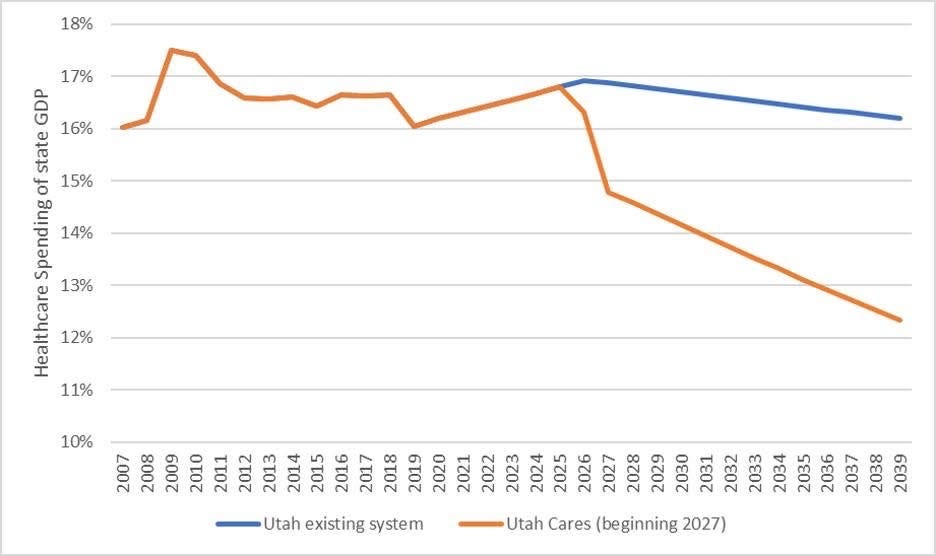
I encourage you to learn more, read the drafted Utah Cares Act, and join in the campaign to bring this act to the voters of Utah as a ballot initiative at View source at utahcares.health. Success in Utah will lead to replication across the entire country.
Most important, in this election year, save a significant amount of your usual donations to candidates and instead give them to the Utah Cares Political Issue Committee.
Many thanks.

Dr. Joseph Q. Jarvis is a public health physician, chair of the Utah Cares Political Issue Committee and author of several books, including The Purple World: Healing the Harm in American Health Care and What the Single Eye Sees: Faith, Hope, Charity, and the Pursuit of Discipleship.