


By Joseph Q. Jarvis | Published: 23 September 2026
When Jesus of Nazareth was challenged to explain what He meant when He used the term ‘neighbor’ to describe whom we should love, He told the parable of man whose acute needs were met by someone who crossed social boundaries to meet those needs. The parable has become known as the Good Samaritan, because it was a Samaritan who, despite danger, stopped on his journey and had compassion on a half dead injured Jew lying on the road to Jericho, bound up his wounds and took care of him. At the end of the story, Jesus advises his followers to ‘go and do likewise’.
Jesus chose to illustrate mankind’s obligation to care for one another by telling the story of an injured man, half dead, who obviously couldn’t care for himself, and therefore needed someone else to step in. Illness and injury are moments of great need in each life. There is no moral or ethical standard that I know of that does not recognize those healthcare needs as paramount, requiring a response from each of us as neighbors to one another and from society as a whole, which is our neighborhood. Just as Christians are admonished to care for the sick and injured, so are Muslims, Jews, Buddhists, Hindus, and Humanists. This moral obligation we have one to another has been the primal cause of the development of universal care systems in all wealthy nations across the entire globe—except one.
In only one wealthy, developed nation are there millions of people without the health care they need because they can’t afford it, leading to hundreds of thousands of premature deaths and hundreds of thousands of family financial failures. In fact it is the wealthiest nation on earth, the United States of America, where this deplorable lack of adherence to fundamental Christian observance exists.
What happens when a nation fails at one of its most basic societal requirements? Beyond the unnecessary death and financial distress, is there a national price to pay for allowing the sick and injured to wither without care?
The United States is providing an answer to this question. First, when some ill and injured people are left unattended, the remainder of the population is put at risk. Infectious diseases are undiagnosed and untreated leaving contagion at large in the community. When only some of the trauma patients receive care, then the doctors and nurses who provide that care are less well practiced and ready to deliver the care that is required. When we fail at universal care, the burden of disease increases and the cost of treatment consequently expands. The US has a sicker, less productive population because we don’t rise to the Christian call for universal care. And we pay more for the care that is delivered.
Second, and equally important, when we abandon some of our people and leave them without the health care they need, we abandon their communities to a lower standard of living. Where health care delivery is unsupported, hospitals and clinics close. White collar health professions jobs disappear from those towns and cities. The tax base shrinks. Businesses move away. Schools, libraries, roads, sewers, and other public services are weakened financially. Infrastructure weakens and the regional way of life is threatened.
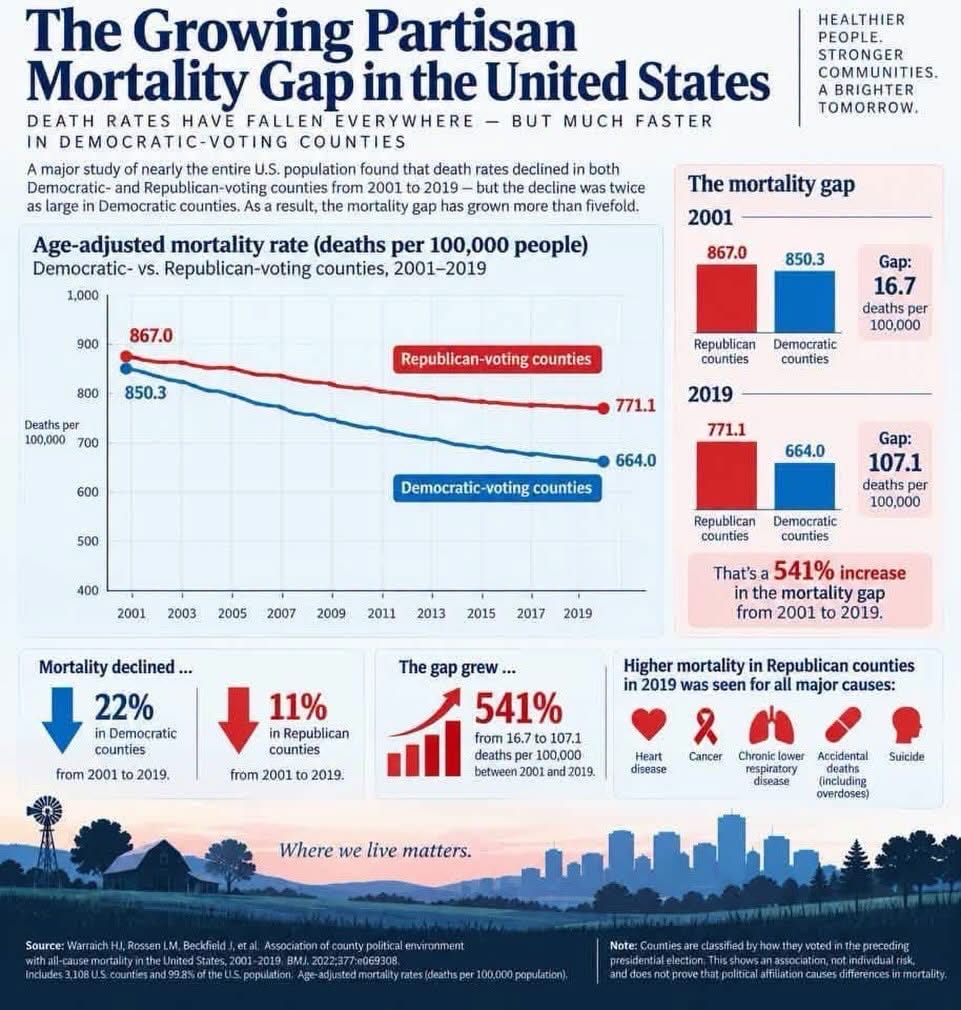
Third, and finally, as communities witness increasing death rates and declining social structure when health services are unsupported where they live, while other regions of the country receive better health care funded primarily with public dollars leading to longer, more productive lives and a higher standard of living, there will inevitably be a fracture in the social fabric. In the United States, urban areas tend to be blessed with better health care services while rural areas are left behind. In general, in the US, urban areas are blue or democrat leaning, while rural areas are red or republican leaning. As illustrated in the graphic below, for at least 20 years there has been a trend toward higher mortality rates in republican areas of the country, with the mortality gap growing steadily for decades. I believe this widening gap in mortality at least partly explains the increasing anger and hostility arising between the two national political parties.
It is time for the United States of America to live up to the ancient call to care for all neighbors which is inherent in our founding documents. Most Americans, when polled, agree that health care should be universal. Better, simpler care financed fairly for all would improve the way of life for all Americans, rich, poor, urban, rural, red, blue, or purple. We would save lives and save on health care costs. We can be more productive, more healthy, and less angry with one another.
Please visit View source at utahcares.health to learn more. AND please DONATE to this campaign to give Americans a chance to vote for Good Samaritan care for everyone in the US.

Dr. Joseph Q. Jarvis is a public health physician, chair of the Utah Cares Political Issue Committee and author of several books, including The Purple World: Healing the Harm in American Health Care and What the Single Eye Sees: Faith, Hope, Charity, and the Pursuit of Discipleship.