


By Joseph Q. Jarvis | Published: 3 October 2026
For two days this week I hosted a couple from New Zealand in my home. My wife, an attorney, has professional connections to the woman who practices law in the greater Auckland area. As is usual for me when I have a chance to converse with people who live elsewhere in the developed world, I asked them about their experience with health care in their home country. Their immediate response was to talk about how terrible their health care system can be. By this they meant that it can be difficult to get a primary care appointment within a week of asking, and some patients must wait a couple of hours for definitive treatment in an emergency room, leading to understandable annoyance.
People all over the world are likely to have been disappointed somehow by the health care delivery system where they live. That is the nature of human built systems just as complaining is built into human nature. I never allow myself to forget that most health care systems in the developed world are underfunded. Naturally, no matter how these systems are intended to function, without adequate funding they will fail at times.
After listening to their complaints I asked this couple two standard questions that are my universal health system comparison inquiries: 1) Do you know anyone who has ever been denied medically necessary care because they could not afford it? And 2) Do you know anyone who has been bankrupted by the cost of illness or injury care? Their answers were 1) NO and 2) NO. I have asked people from Canada, Spain, Portugal, the UK, Austria, Germany, Switzerland, Japan, Australia, and Italy the same questions. The answer to each question is always NO.
However, as a citizen of the United States of America, the wealthiest nation in the world and the nation that spends more on health care, by far, than any other nation, I must answer these two questions as follows: 1) Yes-millions of American patients are denied health care every year because they can not afford it and plausibly 200,000 of my fellow citizens die prematurely every year due to this health system failure; and 2) Yes-500,000 Americans are bankrupted every year due to health care costs.
American health system dysfunction is orders of magnitude worse than any problems or annoyances experienced in health care delivery anywhere else in the developed world. This fact is in stark contrast to what is routinely and repetitively asserted in the US over and over again about change in our health care system. Whenever the subject of health system reform comes up (and it does often around me) people in the US tend to think that somehow change in healthcare will make things worse. Would be healthcare experts seem to come out of the woodwork to decry how terrible socialized medicine is, how long the wait times are in Canada, how death panels kill grandmas in the UK, how people in other nations are benefitting from the development of new drugs and devices in the US made possible by our better health care business model (or in other words, better profits). Whenever the government gets involved, they say, things go very bad (government can’t be the solution for the problem because government is the problem, etc. etc). None of this is remotely true.
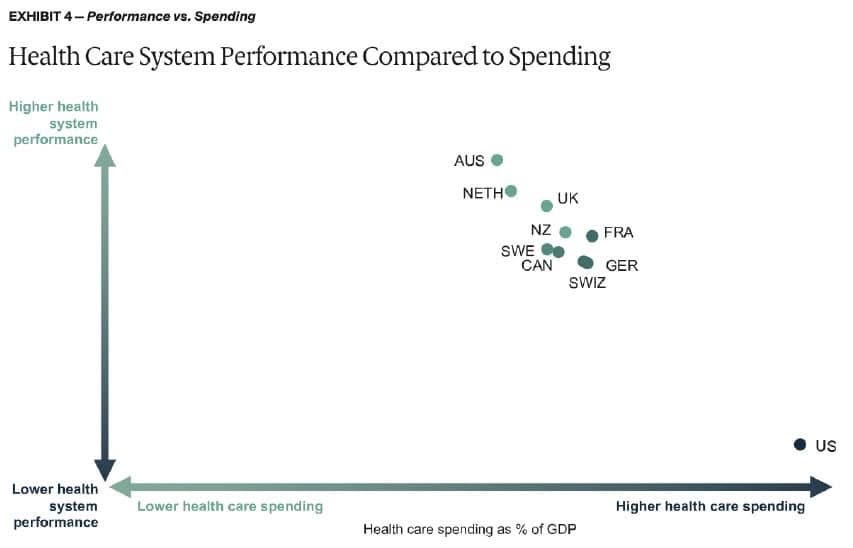
To all of you auto-moronic commentators on health care reform, please stop repeating the nonsense propaganda that the US medical industrial complex pays its PR staff and lobbyists to develop and deploy in an effort (so far successfully) to salt the political ground where we should be growing and harvesting a better, simpler health care system funded fairly for all. American health system performance is the laughingstock of the developed world. The chart below is a simple way to understand this. Choose virtually any parameter to measure real health system performance and you will find American health care lagging, usually well behind other wealthy nations.
My guests from New Zealand, once I had a chance to tell them about how American patients are treated (or not), were aghast. As are my friends from anywhere else among wealthy nations. Americans wait far longer (on average) for care and walk away with bills that bury their household budgets. No one in New Zealand can fathom how much Americans pay at the point of service for care. It is stupefying and we Americans should have long ago absolutely rejected the businesses that propagate this financial carnage and the politicians that support them.
The truth is that a very few other wealthy nations have chosen socialized medicine (meaning that health care is publicly paid for and delivered by government owned hospitals and government employed doctors and nurses). No one in the US (including me) has seriously proposed that for American patients. But all other wealthy nations HAVE adopted a very important starting point for their health care system, whether socialized or not: universal financing for care. It is not just an international norm to assure that every resident in your nation has health care financing, it is how ALL wealthy countries operate, except the US. Most of the money in health care systems around the world is tax money. How else do you go about making sure that every resident has health care financing? Because health care access is universal elsewhere in the developed world, it is less expensive. It turns out that if you do well in caring for your populace by spending healthcare taxes on patients instead of profits people are healthier and you have lower health care costs.
And here is another irony. American health care is also mostly paid for by taxes. In fact, because American health care is so much more expensive than care elsewhere in the developed world (please see the chart below) the tax burden for health care in the US is THE HIGHEST IN THE WORLD. That’s correct. Americans pay higher health care taxes than do the citizens of any other country, including the taxpayers in countries with socialized medicine. And part of the reason for that extra cost is because we fail to support universal care. We leave people to die from treatable conditions because they can’t afford care. It’s that simple.
I have learned from 35 years of health reform advocacy that many of the auto-moronic commentators on health system change are unconcerned about facts and therefore unpersuadable. I am not writing this essay for them. I am writing to those of you who have heard the constant drumbeat about socialized medicine, death panels, wait times, etc etc., and are either made uncertain by those comments or are truly fearful about what health reform might do. Many Americans are generally healthy and therefore have had little personal experience with the perverse incentives of American health care. They believe that the health insurance they have must be good and they cling to it in ignorance of what is truly wrong with it and fear about losing it. To you I offer an alternative vision.
The Utah Cares Act offers you a chance to have better, simpler health care financed fairly for everyone. It is not socialized medicine. It is public funding (like we have been doing for 75 years in the US) and private health care delivery. It is freedom to choose your doctor and hospital (without fear of a surprise bill because you unknowingly received care out of network). It is freedom to choose your career, job, pathway in life, marriage (or divorce) without fear of losing your health financing. It is freedom from medical bankruptcy. It is freedom to pursue your best health in the interest of pursuing your best life, liberty, and happiness.
Read the Act at View source at utahcares.health where you can also find the economic studies that document the fiscal soundness of this proposal.
The Utah Cares Act will become law when you rise up with your fellow citizens and throw the profiteering medical industrial complex on the scrap heap of history where it belongs. We will have better simpler care financed fairly for all when we get the Utah Cares Act on the ballot in 2028 and campaign through to victory at the polls. The Utah Cares Political Issue Committee needs you to join in with us through volunteering and through donations.
DONATE TODAY AT View source at utahcares.health
Many thanks.

Dr. Joseph Q. Jarvis is a public health physician, chair of the Utah Cares Political Issue Committee and author of several books, including The Purple World: Healing the Harm in American Health Care and What the Single Eye Sees: Faith, Hope, Charity, and the Pursuit of Discipleship.