


By Joseph Q. Jarvis | Published: 22 October 2026
In 2004 Jon M. Huntsman Jr. ran, for the first time, for Governor of Utah. At the time I had already become the leading proponent of single payer health system reform in the Beehive State. As such, I sought an opportunity to meet with all candidates for Governor and the State Legislature. Generally, I had little success even getting a meeting with Republican candidates (I was often able to meet with Democrats but generally found them to be either outright dismissive of single payer or unreliable as a political ally). Through a mutual friend, I was invited to meet with candidate Huntsman. He gave me his whole attention at our first meeting, listened carefully, asked good questions, and then accepted the reading material I provided with a promise to meet again and discuss. He was as good as his word (unlike virtually all other politicians I have met, before or since). At our second meeting it was clear that he had done his own homework. Again, he had prepared good questions. As the meeting came to its end he summarized that he believed single payer would ultimately be the health policy solution that put an end to the rapid growth of health care costs while preserving quality care for every patient. He noted that getting to single payer health reform would be politically very difficult because of the political power of the medical industrial complex. He promised that if elected he would make health reform a priority and would be guided by single payer principles.
He was elected governor of Utah in 2004 and within a year hosted a very public, high profile conference on health policy on the campus of the University of Utah School of Medicine. He asked me to be one of the speakers at the conference. He himself gave the opening address. We met again and he asked me for ideas about legislation that would move the state of Utah stepwise toward single payer reform. I responded that I believed that he could make measurable progress for Utah patients if he would sponsor legislation that would change the charter of the Public Employees Health Plan (PEHP) so that it could provide a health benefit to any Utahn willing and able to pay its premium rather than be restricted solely to providing health benefits to public employees and their beneficiaries.
PEHP is a private, non-profit trust fund organized under the statutes of Utah to serve government employees, both local and state. It has long been known to be the most efficient payer of health services in Utah other than Medicare and Medicaid, with an overhead of 4%, far less than the commercially available health plans which average overheads of more than 15%.
Gov. Huntsman agreed to run the legislation. His staff recruited a member of the Utah House of Representatives, a moderate Republican, Steven Mascaro, to run the bill. I met several times with Rep. Mascaro and attended all of the meetings generated about the bill. I remember one such meeting called by State Senator Curtis Bramble which featured that Senator opening the meeting with a statement about how the sponsoring Representative must be smoking something to have agreed to run this bill. The CEO of the Utah Health Insurance Association, Kelly Atkinson (a former democratic member of the Utah House of Representatives) was outraged by the bill and pulled out all of the stops at his disposal. The bill was assigned to the most unfriendly committee possible. A hearing date and time were set. As I went about the customary visits with each member of the committee, I was followed by UHIA lobbyists. Each time I spoke with a member of the committee they were approached within ten steps of leaving me by UHIA personnel. Rep. Mascaro had all of his other legislation threatened by legislative leadership. As I recall, he had four other bills that he was sponsoring and all of them were held up in the Rules Committee. He was told that none of them would be assigned a hearing unless he changed this one bill substantially to suit UHIA. Legislative leadership was aware Gov. Huntsman favored the bill and they didn’t dare simply kill it.
After holding out gamely for awhile, Rep. Mascaro caved in to the pressure. Without warning me, he showed up to the committee hearing with a substitute bill which transformed the legislation into what is charitably called ‘a study bill’. I had come to the hearing with the intent to provide opening testimony for the bill. As I sat at the table with Rep. Mascaro, he made me aware of his unilaterally made change in the bill. I simply got up and walked away from the hearing. I had no interest in supporting a meaningless study bill which probably was not going to pass anyway. Rep. Mascaro was targeted thereafter by hardline Republicans and in 2008 was primaried out of his seat in the legislature. I respect him for his effort.
Neither Rep. Mascaro, nor I, nor Gov. Huntsman had anticipated the amount of animosity that this simple, incremental proposal for health system reform would generate. We were simply recognizing that health care costs were the number one concern for Utah voters at the time (and have been ever since). A major contributor to high and rising health care costs are the administrative costs of American health insurance. PEHP is a very lean payer for health services in Utah which at the time already provided a health benefit to about 200,000 Utahns who were public employees or their family members. We proposed that the so-called health insurance market would be well served if that very efficient business model could be made available to more Utahns. The Utah Health Insurance Association, however, viewed that change in ‘market’ dynamics as an existential threat and acted accordingly.
After this legislative debacle, I decided to run for the legislature myself, which I did twice: in 2006 as a Republican nominee for the State Senate and in 2008 again as a Republican nominee but for the State House of Representatives. I ran on a platform of single payer health system reform, calling it constitutionally, morally, and fiscally conservative (which it is). For each election I had the outright support of Gov. Jon Huntsman. He appeared with me in public, had photos taken together with me, and shared a booth at a street fair with me. I failed in both elections because the district in which I reside is overwhelmingly democrat and most voters just voted a straight ticket, probably without even knowing who I was or what I proposed.
I have met with many politicians during my career as an advocate for real and sustainable health system reform. There are many very earnest, hardworking, and basically good people in politics. But Gov. Huntsman remains my favorite. Together we failed to make a substantial change in business as usual in American healthcare. But he did his own homework, learned what the fault lines were, and made an effort to do something about it. Of course, he came at this subject from the perspective of being a member of the Utah family which has been trying since before his political career to do something to help all patients in Utah. The Huntsman Cancer Center makes every effort to treat all cancer patients, regardless of ability to pay. The Huntsman family is also actively serving patients with mental illness. Gov. Huntsman came at the problem of high health care costs with experience observing how American healthcare is generally failing to provide the care that people need.
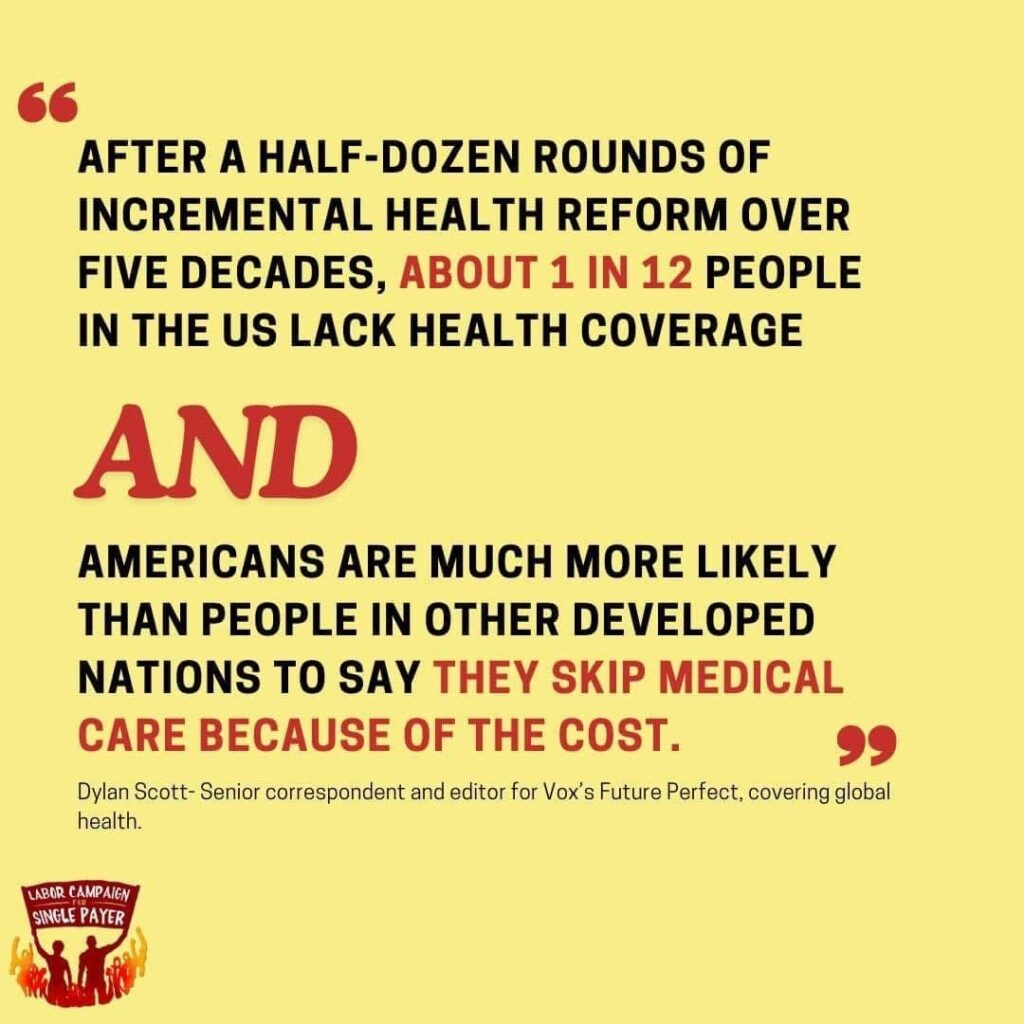
The major lesson I learned from this experience is that incremental health reform strategies DO NOT WORK! The powers that be in American health care, the medical industrial complex, like the Utah Health Insurance Association, are well heeled. They have the resources to beat down any incremental effort that they view as at all threatening to their profiteering. They will expend the same effort whether they are fighting the smallest change or opposing the real and sustainable reform—single payer. Incremental changes in health care are always co-opted by the medical industrial complex (see the photo below). Why—because incremental changes do not change the fundamental function of a health care system which is corrupted. The corruption in health care will inevitably overtake every well-intended incremental change, Obamacare being the most recent example.
It is for that reason that in recent years I have chosen to work towards fashioning a single payer bill for Utah. Along with others, I have succeeded. The Utah Cares Act will actually change how health care business is done in Utah. The principal change that will happen if the Utah Cares Act is implemented is that PEHP will become the sole payer for health services for ALL UTAHNS and will be renamed Utah Cares. Learn more about better, simpler care financed fairly for all at View source at utahcares.health
While you are visiting the Utah Cares website, please donate whatever funds you can to the campaign to bring the Utah Cares Act to the voters of Utah as a ballot initiative in 2028.
Thank you.
Dr. Joseph Q. Jarvis is a public health physician, chair of the Utah Cares Political Issue Committee and author of several books, including The Purple World: Healing the Harm in American Health Care and What the Single Eye Sees: Faith, Hope, Charity, and the Pursuit of Discipleship.